


Independent developer or freelancer
Build a customer-specific tool without first recreating storage, agent runtime, UI foundations, workflow execution, or project structure. Begin with a library or a plugin and preserve a clear upgrade path.

Development use
Use one focused library, extend the application, add a complete module, or build your own service and interface over the CanDoItAll backend.
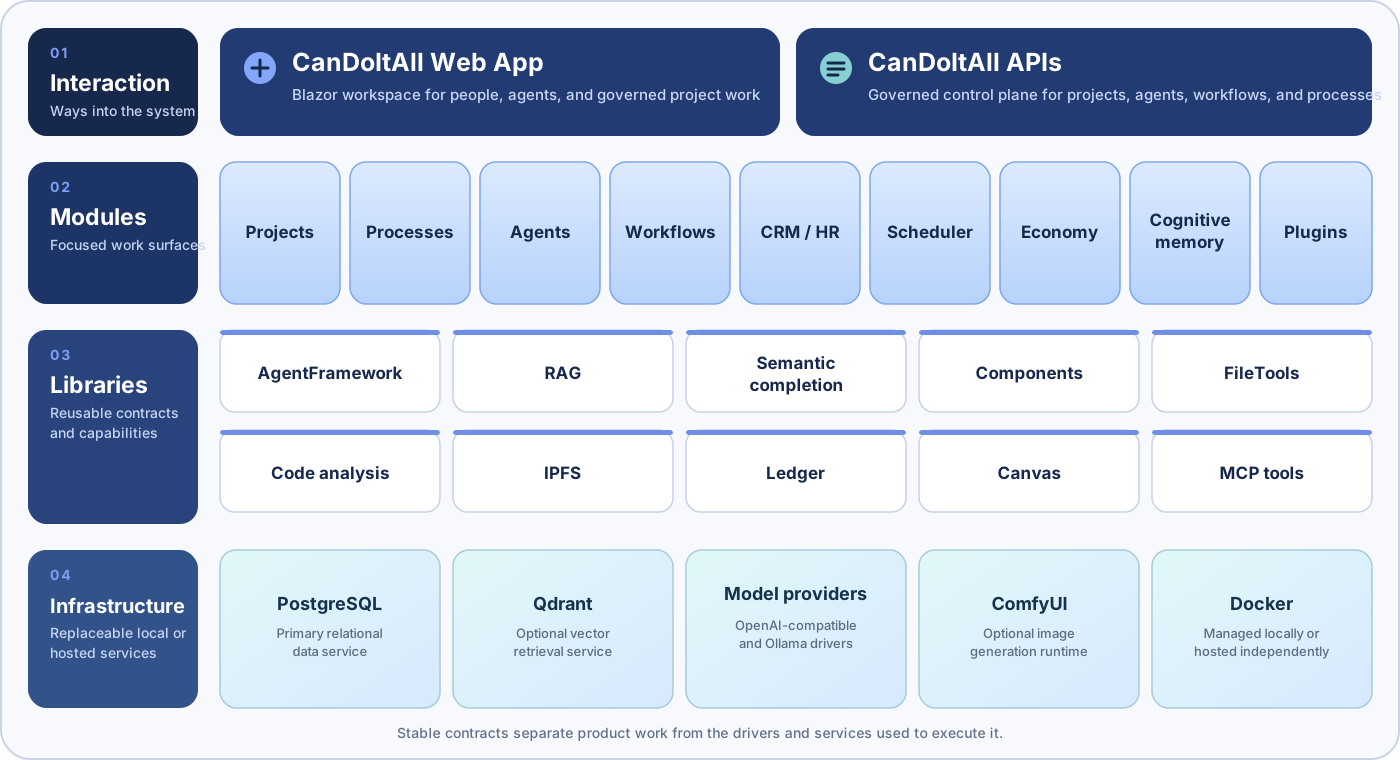
Four ways to build
CanDoItAll is an application and a framework. A freelancer, internal engineering team, or product company can start with the smallest useful boundary and expand only when the project needs it.
Reference capabilities such as AgentFramework, Components, FileTools, IPFS, Ledger, code analysis, RAG, or semantic completion in your own solution. The result can be a completely different product and does not need to be an agent application.
Explore the frameworkKeep the existing project operating system and add integrations, executors, or provider-specific behavior through the plugin boundary. This is often the shortest route when the main workspace already fits.
Explore PluginsAdd a first-class product area that shares the app shell, identities, projects, data, agents, workflows, and governance contracts. Choose this when the capability belongs inside the operating system.
Browse function modulesKeep governed projects, agents, processes, workflows, and data services behind the APIs while your product owns the service layer, user interface, customer experience, or integration topology.
Explore functions overviewA decision lens
Reuse the stable plumbing. Spend your engineering attention on the workflow, domain, and experience that make the project yours.
Build a customer-specific tool without first recreating storage, agent runtime, UI foundations, workflow execution, or project structure. Begin with a library or a plugin and preserve a clear upgrade path.
Create a company module or a separate interface over the APIs while connecting existing identity, information systems, deployment, and operating standards.
Use the framework as an accelerator beneath a distinct product. Own the customer experience and domain model while selectively reusing the components and services that are expensive to rebuild well.
Why this foundation
C# and .NET offer strong typing, runtime performance, a mature ecosystem, and cross-platform reach from backend services to rich user interfaces.
CanDoItAll adds reusable project, agent, workflow, process, storage, integration, and UI boundaries on top—so a new system can begin above the lowest-level plumbing.
Use C# for backend services, Blazor web interfaces, .NET MAUI applications, shared libraries, automation, and even nanoFramework scenarios for constrained embedded devices.
Strong types, dependency injection, reflection, compiler diagnostics, and analyzers make boundaries inspectable for engineers and provide precise feedback to AI coding agents.
C# is high-level enough to avoid low-level ceremony while retaining enterprise structure. Compared with many Java codebases, equivalent behavior can often be expressed with less boilerplate, reducing context and token use.
Inspect the code, debug the complete path, replace a driver, and keep the system deployable on infrastructure you control.
Open for real adoption
Use the complete application or selected libraries under the published repository license terms. Meaningful adoption is welcome whether or not you need paid help.
Optional acceleration
A focused paid session can map your intended product to the right libraries, extension boundary, deployment model, and first proof. Your team keeps control of the implementation while spending less time discovering avoidable dead ends.
Explore technical training and support