


Reduce operating scope
Each run stays understandable because roles and decisions focus on one bounded responsibility.

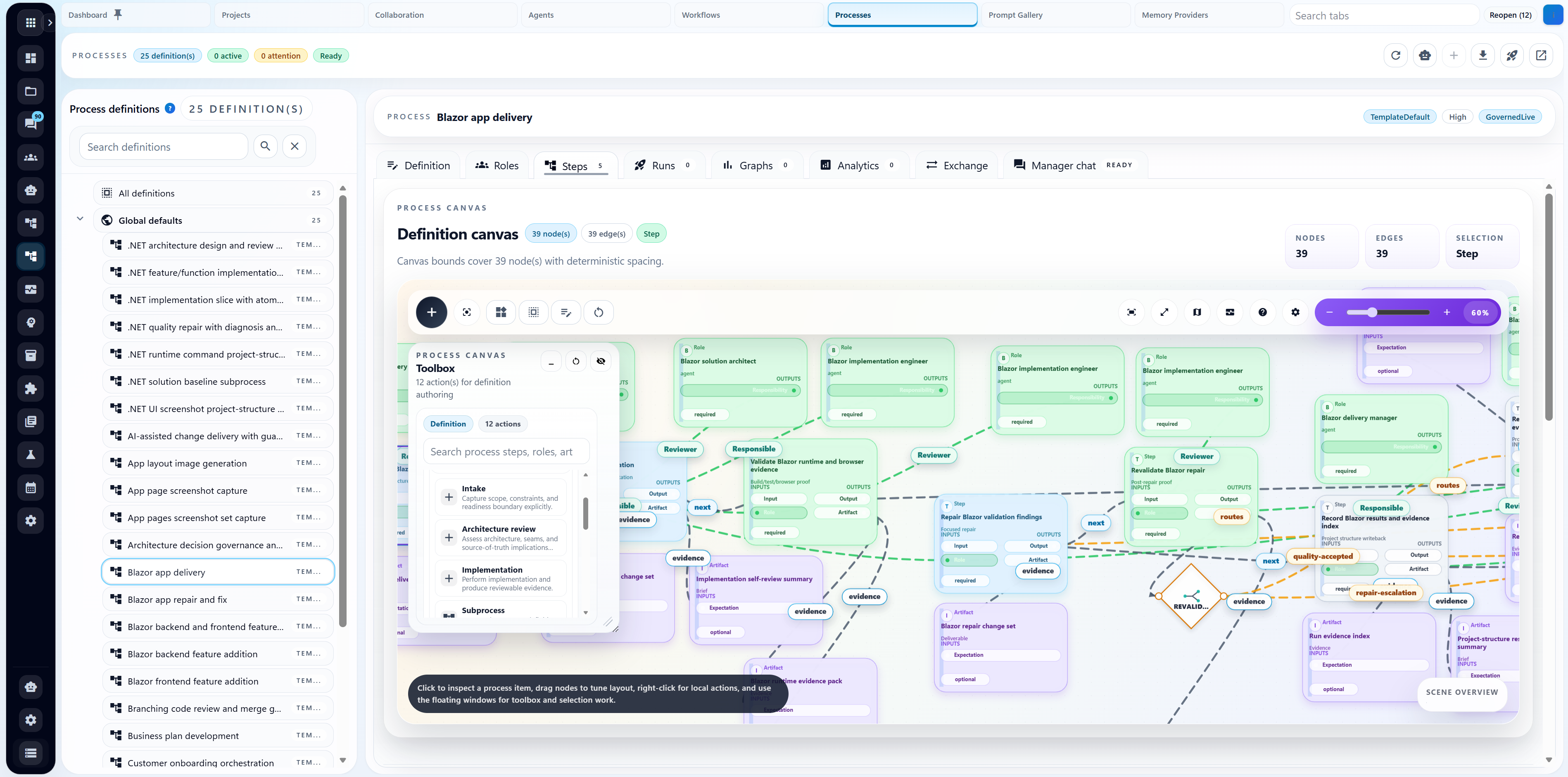
Define roles, steps, contracts, routes, approvals, and artifact expectations—then inspect execution, recovery, and evidence.
Inside the module
Follow a definition into its live execution. Every process run has a manager AI agent observing progress, artifacts, recovery needs, and decisions within the process’s configured self-governance boundary.

Manager agent · Every run
Every process run is paired with a manager AI agent. It observes the run across steps and subprocesses, tracks the evidence expected from each role, and keeps recovery and decisions connected to the process policy.
The configured level, permissions, and approval gates determine how far the manager may go. It can always surface a problem; it may intervene only when the process explicitly allows it.
Read step state, role assignments, events, approvals, subprocess activity, and every required artifact from one operating context.
Distinguish a missing or invalid artifact from a failed step, a waiting approval, a role problem, or a decision that needs more context.
Ask the responsible role for corrected evidence, route rework, and help restore the artifact chain instead of abandoning the whole run.
Support a decision and apply a permitted recovery only at the allowed self-governance level. Otherwise, explain the issue and ask the authorized person to decide.
Subprocesses
A parent step can call a reusable subprocess for one bounded outcome. The child runs its own roles, steps, artifacts, events, and recovery, then returns its contracted result to the parent run.
The parent preserves the wider objective and waits at a clear process boundary.
Its team, manager oversight, decisions, artifacts, and recovery remain inspectable.
The parent continues only with the output and artifact trail the subprocess promised.
Each run stays understandable because roles and decisions focus on one bounded responsibility.
A stable subprocess can serve several parent processes without duplicating its steps or controls.
Tune, replace, retry, or recover the smaller unit while preserving its relationship to the parent evidence trail.
Run-specific staffing
At launch, select a different team or override individual role assignments while the reusable process definition stays the same. Every run records who actually performed each role.
Select a team whose agents use secured local LLMs and approved local tools when project data must stay inside a controlled environment.
Repeat the same process with a revised process version, team, agent, or model assignment, then compare artifacts, corrections, duration, tokens, and cost to measure improvement.
What it covers
The module has a clear operating boundary while remaining connected to the people, agents, automation, and evidence around it.

Author global or project-scoped processes with criticality, autonomy, operating mode, roles, steps, branches, loops, and artifact expectations.
Build the process on a canvas while editing role and step responsibilities in focused panels.
Run non-mutating checks, resolve every required role to a specific person or AI agent, inspect readiness, and review preflight estimates before creating the durable run.
Resolve AI-owned roles through CRM / HR bindings and execute them through AgentFramework with permitted tools, required artifacts, and evidence expectations.

Require artifacts, valid outcomes, approvals, and legal state transitions before work advances.

Monitor active and waiting parent/subprocess runs with current step, assigned agent, progress, event stream, details, and permitted control actions.

Observe actual or estimated provider cost, token volume, elapsed time, event rate, and tool usage by history window, definition, run, and project context.

Keep waiting approval, blocked, failed, refused, rework, cancellation, escalation, recovery, files, tool receipts, and history as operating records.
How it connects
Projects provide scope, CRM / HR resolves roles, Agents perform governed work, and Workflows can handle bounded automation inside the run. Outputs and evidence return to the originating project.